
Free Jerome Powell
Populist attacks on central bank independence are a cause for concern

Attacks on the Federal Reserve’s independence have continued, with the Fed chair, Jerome Powell, coming under investigation by the Justice Department under Trump.

This is very, very bad. I don’t know why I didn’t expect this kind of chicanery from the administration, but here we are.
Why care?
Central bank independence is the notion that the central bank should be free to pursue its policy objectives, which are usually low and stable inflation and/or full employment. Independence is important, as central banks must make policy commitments to be able to control inflation. If they are easily influenced by other branches of government, they can quickly lose their mandate, leading to episodes of high inflation. An inflation-averse central banker will avoid inflation, but ex-post many people (and politicians) feel that such inflation-averse policies are unnecessary, not realizing that current inflation depends on future expectations of inflation; a central bank that did not adopt inflation-averse policies in the past will experience higher inflation in the present and have a harder time controlling it in the future.
And of course, most people simply do not understand monetary policy, and feel that low rates are “good”. See for example the current President.
The classic example is that of a political business cycle, where the leaders of a country pursue popular inflationary policies (like very high deficit spending or expansionary monetary policy) to maintain power or to get elected. This isn’t just a hypothetical; this has already happened in the U.S. during the Nixon era when President Nixon pressured then chairman Arthur Burns to pursue expansionary monetary policy leading up to his election. This, not oil shocks, was the main reason for high inflation during the 1970s.
Latin America’s struggles with central bank independence are a good case study.
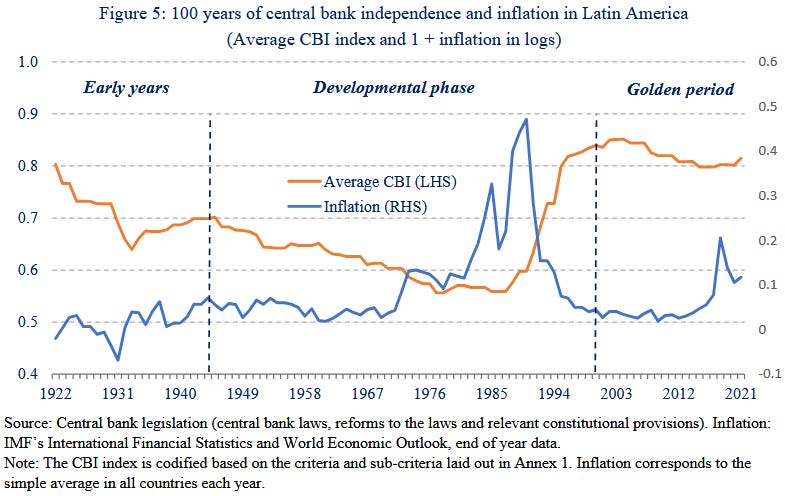
Jácome and Pienknagura (2022) conclude: “A steady erosion [of central bank independence] in the aftermath of the great depression resulted in a period of high and volatile inflation, and in some cases, hyperinflation. By contrast, the decisive steps taken in the early 1990s to grant independence to central banks from political influence led to the taming of inflation in the region.”
Below are some figures from their paper, Central Bank Independence and Inflation in Latin America—Through the Lens of History.
During the developmental phase, governments “enhanced their influence on the formulation of monetary policy and even on its implementation. Moreover, they shaped policy decisions even from outside the central bank—at different periods of time.” In other words, central bank independence was eroded.
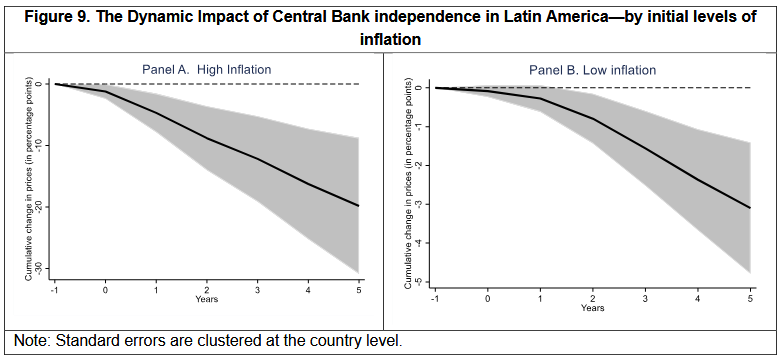
They also find that independence helps both in high inflation and low inflation environments, though it matters more in the former case.
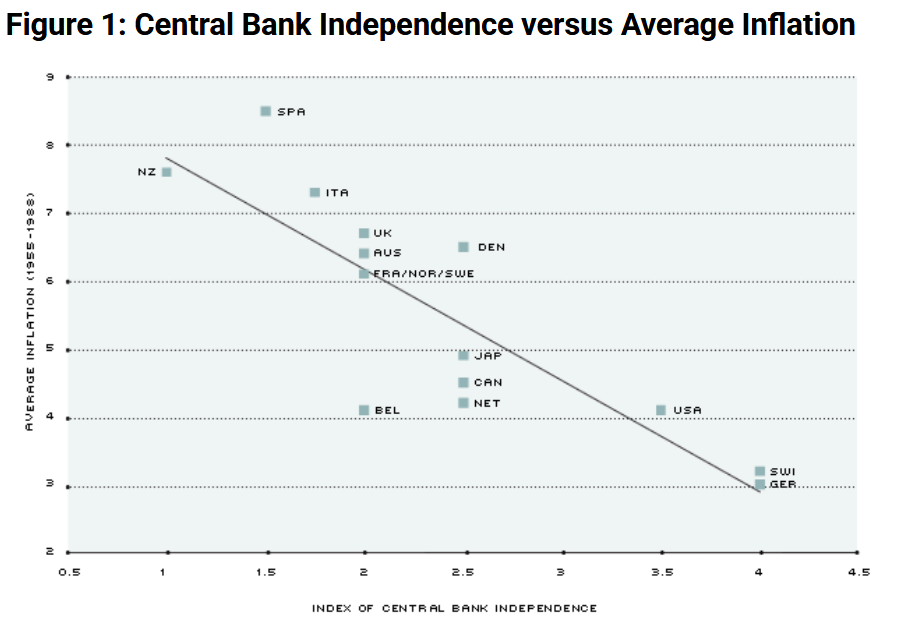
For developed economies, there is the famous 1993 paper from Alesina and Summers, demonstrating the negative relationship between independence and inflation.
Hyperinflation
Hanke-Krus (2013) is a complete table of (nearly) every case of hyperinflation for which there is data. They episodes of hyperinflation as beginning with a month with more than 50% inflation, ending after 12 consecutive months of less than 50% monthly inflation.
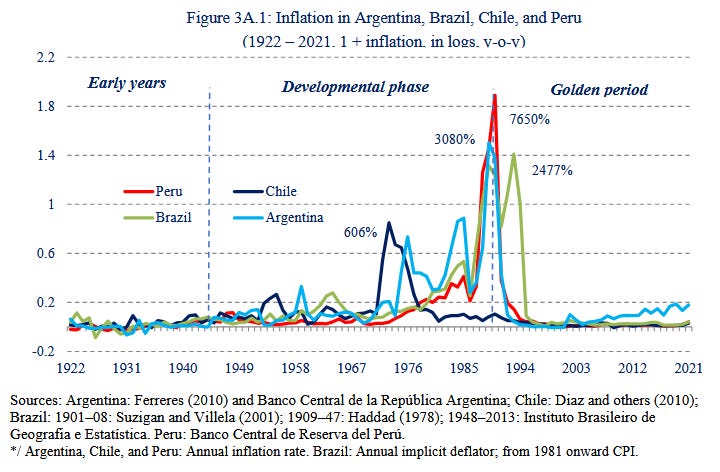
Fun fact: most cases of modern hyperinflation come from either a) war (e.g. during WW2), b) leaving the USSR, c) total domination of the central bank, or d) all of the above. Zimbabwe in 2007 experienced a daily inflation rate of about 98%, or a price doubling every 24.7 hours. Their central bank existed to print money for the executive. Yugoslavia in 1992 experienced 64.6% price inflation per day, or a price doubling every 1.41 days. Latin American central banks, as mentioned, were not independent before major reforms in the 90s.
Argentina, Brazil, Bolivia, Chile and Peru all experienced hyperinflation which was not stopped until they reformed their central banks.
If you like a low and stable rate of inflation, you should be quite concerned.